
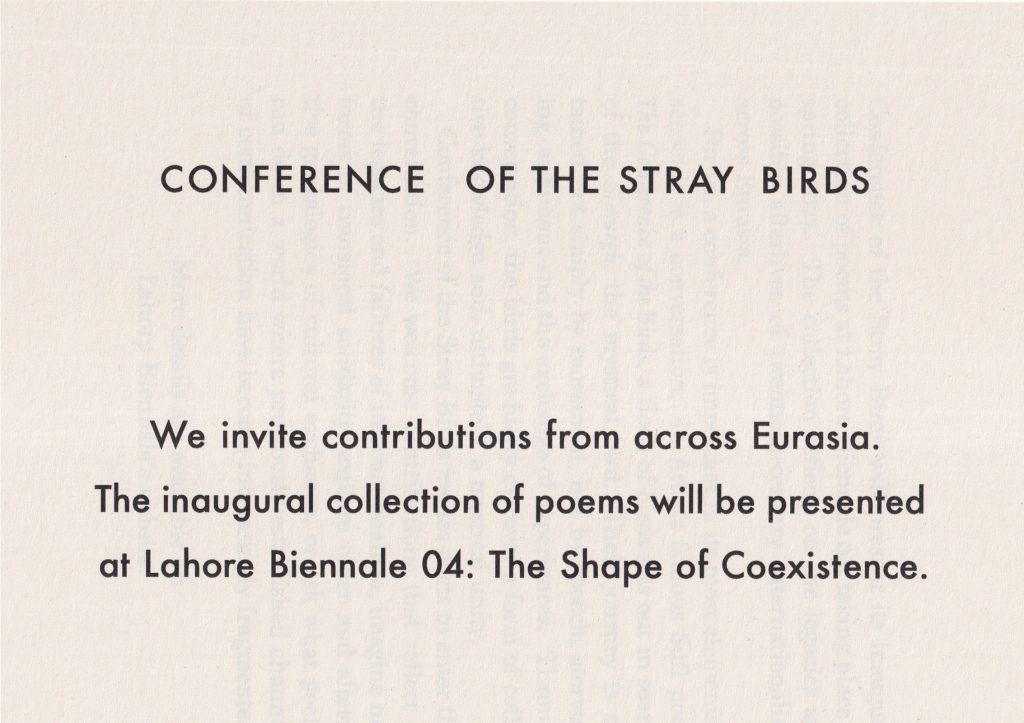
Open call for poets: Conference of the Stray Birds invites contributions from across Eurasia
Conference of the Stray Birds will present its inaugural collection of poems at Lahore Biennale 04: The Shape of Coexistence, taking place in spring 2027. The collection reflects on the legacies and possible afterlives of twentieth-century internationalism across Eurasia.
Of particular importance to us are the internationalist writers’ conferences that took place across Soviet Central Eurasia in the post–World War II period. At these gatherings, writers and poets from different countries came together to share ideas and aspirations for peace, solidarity and cross-cultural dialogue. Many decades have passed since then, and the tradition of international poetic gatherings has been replaced by other forms of global cultural production. Nevertheless, many fundamental questions that animated them remain unresolved. What can be inherited from the internationalist projects of the twentieth century without simply reproducing their limitations?
A renewed internationalism would, of course, entail a certain reset: a critical examination of the twentieth century’s networks of solidarity, the ways in which they failed, the exclusions and asymmetries they sometimes reproduced, and the ways in which their universalist ambitions could themselves become entangled with geopolitical interests. But it would also project a new horizon of solidarity. Can poets reclaim a role as mediators between places, languages and communities? Can we reactivate connections across the continent in 2027, or imagine instead new networks of solidarity based on translocality — connections that do not necessarily pass across national borders or depend on a shared political project? How can this be articulated through a poetic form?
The title Stray Birds, borrowed from Rabindranath Tagore’s 1916 collection of poems, points toward this possibility. A “stray bird” is both a poetic form — a brief, condensed, elusive fragment in which a single verse can constitute a whole poem — and a figure for a practice that exceeds national belonging. Birds wander beyond the confines of their flock; likewise, poets can move between languages, places and traditions. Poetry can therefore become a supranational practice: one that travels across borders not by erasing difference, but by creating spaces in which differences can encounter one another.
Another possibility is to project a future by looking further back, toward forms of cultural connectivity that predate twentieth-century internationalism. The continent’s earlier traditions of exchange — including the Persianate cosmopolis, which connected literary, intellectual, and artistic communities across vast swathes of Eurasia through shared languages, texts, education and itinerant forms of knowledge — might be thought of, speculatively, as a harbinger of internationalism. Unlike the institutional internationalism of the twentieth century, these networks did not require nation-states or formal international organisations. They operated through movement, translation, correspondence, pilgrimage, education, trade and literary exchange. Their geography was neither strictly national nor entirely universal: it was made through overlapping routes, cities, languages and communities.
For us, a conference is therefore important in its most elementary sense: it is a conversation. In Attar’s famous Sufi poem The Conference of the Birds, a flock of birds sets out in search of the Simurgh, the mystical bird. Their journey is sustained not simply by movement, but by speech, storytelling, argument and the exchange of experiences. Through conversation, the birds gradually discover a form of collective knowledge and, ultimately, a mystical unity.
Conference of the Stray Birds invites poets to enter this conversation. We welcome contributions that reflect on the legacies and failures of internationalism, imagine new forms of translocal solidarity, explore older and alternative genealogies of cultural exchange, or ask what poetry can do in a world where previously established channels of communication have become increasingly fragmented.
The conference is organised by media scholar and practitioner Furqat Palvan-Zade (Uzbekistan), who will lead the selection committee for the inaugural collection of poems to be presented at Lahore Biennale 04 in 2027. The resulting print publication will bring together poems in their original languages, accompanied by translations into English and Urdu.
The application form is available here. Please submit your poem by October 15, 2026.